Story: By Care Providers
Commissioner’s Remark at Inaugural Perinatal Summit
Demonstrating Massachusetts’ deep commitment to improving perinatal health outcomes and closing equity gaps in maternal and newborn health outcomes. The Commonwealth’s Commissioner for Public Health opened the first ever statewide summit to improve systems for transfers of care between settings.
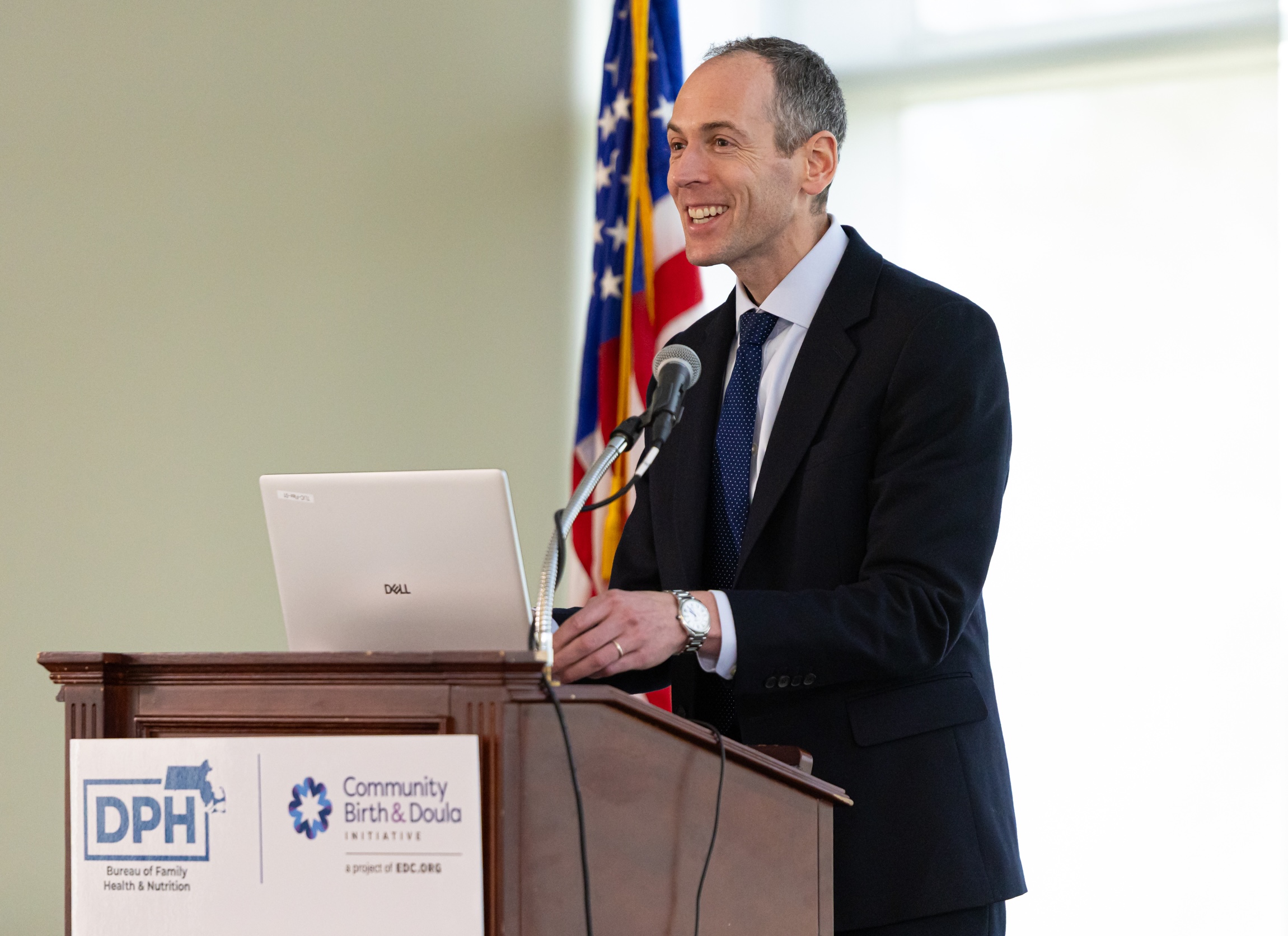
If we get this right. . . if we truly create a connected, equitable, and high-functioning perinatal network of care . . . then we will do more than just improve outcomes. We will transform what it feels like to give birth in our Commonwealth.
Good afternoon, everyone.
It is an honor to be here with you at this first-ever Massachusetts Perinatal Networks of Care and Transfer Summit.
I want to begin with gratitude for the work you do every day – often unseen, usually under pressure, and always deeply consequential. Gratitude because your presence is a signal that something important is underway. The fact that you are here demonstrates the shared commitment to doing this work differently, doing it better, doing it together . . . collaboratively.
As I look around, I find it truly heartwarming to see midwives, nurses, doulas, paramedics, physicians, researchers, public health leaders – all here in the same place. Traditionally, and far too often, these groups have worked more in parallel than in partnership. Today, we see that changing. And this summit is a clear demonstration of that new spirit of partnership.
This moment came after years of work, advocacy, and, frankly, a growing recognition that we must confront the realities of maternal health in this country and in our Commonwealth.
With the passage of the 2024 Maternal Health Omnibus Law, Massachusetts once again has positioned itself as a national leader. That law is more than a milestone or an initiative. It is a mandate. It challenges all of us to reimagine how we can organize care, how we collaborate, and how we can provide every birthing person with access to safe, high-quality, respectful, and comfortable care. I know that all of you in this room take this charge seriously. I can assure you that the Massachusetts Department of Public Health certainly does, too.
This is an awesome challenge we have taken on. And I mean that in a good way . . . a positive way. We are working to expand access to community-based and midwife-led models of care. We are strengthening the doula workforce. We are supporting the integration of certified professional midwives more directly and intentionally into our health care system. And critically, we are building the systems that enable all of these pieces to function as one cohesive and responsive network of care.
The evidence is clear. A strong, integrated system in which patients can move safely and seamlessly between levels of care leads to better outcomes for both birthing people and their infants.
I’ll be honest… as a physician who has focused primarily on infectious disease, HIV, and gender-affirming care, the concept of out-of-hospital birth was not something I trained in or was familiar with before joining the Department. But as I moved into the world of public health and became more aware of the power and impact of caring for whole communities and populations as well as individual patients, this collaborative, system-focused approach seemed logical and sensible. Then I saw the data. And they were quite compelling. They told a story that simply cannot be ignored or dismissed. They showed clearly that in the context of strong systems, timely mechanisms for transfer of care, and continuous quality assurance for community providers, birth center and home-based care for low-risk individuals results in exceptional outcomes.
The Strong Start Study of Perinatal Outcomes among Medicaid-enrolled patients found that midwife-led community-based care can significantly reduce cesarean rates, prematurity, and low birth weight. This care also increases the rate of vaginal birth after a primary cesarean section. And perhaps most important, this study showed that the greatest improvement in outcomes was among the most historically marginalized populations – Black, Hispanic, and Indigenous birthing people. This work matters deeply because we cannot talk about maternal health without talking about equity.
Different models of care are designed to do different things. Hospital-based care is essential for managing complex clinical conditions and complications. Community–based care is often distinctly positioned to provide continuous, relationship-centered, culturally responsive support . . . especially for uncomplicated, low-risk pregnancies.
The goal is not to choose one model over another. The goal is to build a system in which both co-exist, both are valued, both are connected, both provide the highest quality of care and the best experience possible for every pregnancy. Furthermore, a model of care that meets patients where they are and connects them with providers who share or understand their cultural backgrounds and lived experiences can help build stronger, more trusting, and open relationships.
The connections that are rooted in trust are what matter most when something does not go as expected. Because in perinatal care, as in all of medicine, complications arise, and things don’t always go precisely as planned . . . or as hoped. A birthing person must be able to move from a home or birth center to a hospital seamlessly, without fear, without stigma, and without having to re-explain themselves. And without losing their dignity or voice in the process.
Working together to support continuity of care and clear communication during transfers to the next level keeps the patient at the center. This kind of collaboration leads to a more positive and reassuring experience for the patient, and it plays a critical role in preventing harm.
In addition, a smooth, well-executed transfer can lead to improvements in something we don’t talk about nearly enough: secondary trauma for the providers involved – for midwives, for EMS teams, for nurses, and for doctors. We all carry those moments with us. And that is why the work you are doing here . . . building shared protocols, strengthening communication, and importantly, building trust across disciplines . . . is so essential.
We are already seeing what is possible. Through the Community Birth Integration and Doula initiatives, we have made real progress. We established the Board of Registration in Midwifery and advanced licensure of certified professional midwives. We have updated birth center regulations and distributed grants for midwife-led birth center development in communities that have too often been left behind.
We are also supporting birth center workforce development. Right here, Greenfield Community College is developing educational programs for community midwives. Once launched these will be the first community college-based professional midwife education programs in the Northeast. And just last month, we provided training scholarships to an exceptional cohort of both practicing and aspiring doulas. Three-quarters of this group identify as people of color, collectively offering services in 15 languages. That is what it looks like to build a workforce that reflects and serves our communities.
Across the Commonwealth, we have invested in something that may sound simple but is quite profound – and that is practicing how we work together. I know many of you have participated in these high-fidelity transfer drills. These exercises bring together hospitals, midwives, EMS, and others to simulate those rare but critical moments when a transfer is needed. These kinds of transfers do not happen often, but when they do, they have to go well . . . they have to be right.
The drills have focused on aligning processes and strengthening clinical readiness. Just as important, they have created space to build relationships, deepen the understanding of one another’s roles, challenge assumptions, and replace uncertainty with trust. By the end of April, all five perinatal regions in Massachusetts will have participated in a transfer drill.
That is extraordinary progress. But we all know there is more to do. This summit is about taking that next step – coming together to discuss and refine best practices, to confront misconceptions, and to commit to a shared vision of what a truly integrated perinatal system can look like.
The system we envision is one in which every birthing person – no matter who they are, where they live, or where they choose to give birth – has access to high-quality care. Where respectful treatment is the standard everywhere, not the exception. Where transitions between care settings are seamless, coordinated, and grounded in dignity. And where we recognize that this work depends on all of us, working together.
Because the truth is, the challenges we face . . . from resource constraints to workforce shortages to persistent inequities . . . are too complex for any one discipline, any one institution, or any one sector to solve alone. But together, we have something powerful. Together we have deep expertise, hard-earned experience, and a shared sense of purpose.
And that purpose is what brings everyone in this room together. It is the unshakable commitment to families. It is the belief that every baby deserves the best chance to be born healthy. And it is the hope that every parent can begin that amazing journey feeling supported, respected, well cared for, and safe. That shared commitment is our foundation . . . and our strength.
So, as we begin this summit, I encourage you to lean into this shared purpose. Be open and stay curious. Challenge assumptions . . . your own and those of others. And most importantly, look for opportunities to build something together that none of us could build on our own.
If we get this right. . . if we truly create a connected, equitable, and high-functioning perinatal network of care . . . then we will do more than just improve outcomes. We will transform what it feels like to give birth in our Commonwealth. We will build a system in which every family is seen, heard, and cared for with dignity. And we will replace fragmentation with connection, and uncertainty with trust.
Strengthening care for this generation of families, means strengthening care for the generations to follow. That is the opportunity in front of us right now. It is ambitious. It is bold. And it is worthy of our very best.
Thank you for the work you do every day, and for bringing your energy and commitment to this effort. I am truly excited about what we will build together . . . and the example we can set for Massachusetts and the nation.
Thank you.